Interview with Chat History, Chemical-Weapons History Creator: Assessing the “burned plastic as secret service weapon” Claim
Burned Plastic as Secret Service Weapon
A fact-checking investigation into what chemical-weapons history actually establishes — and what an apartment odor alone never can.
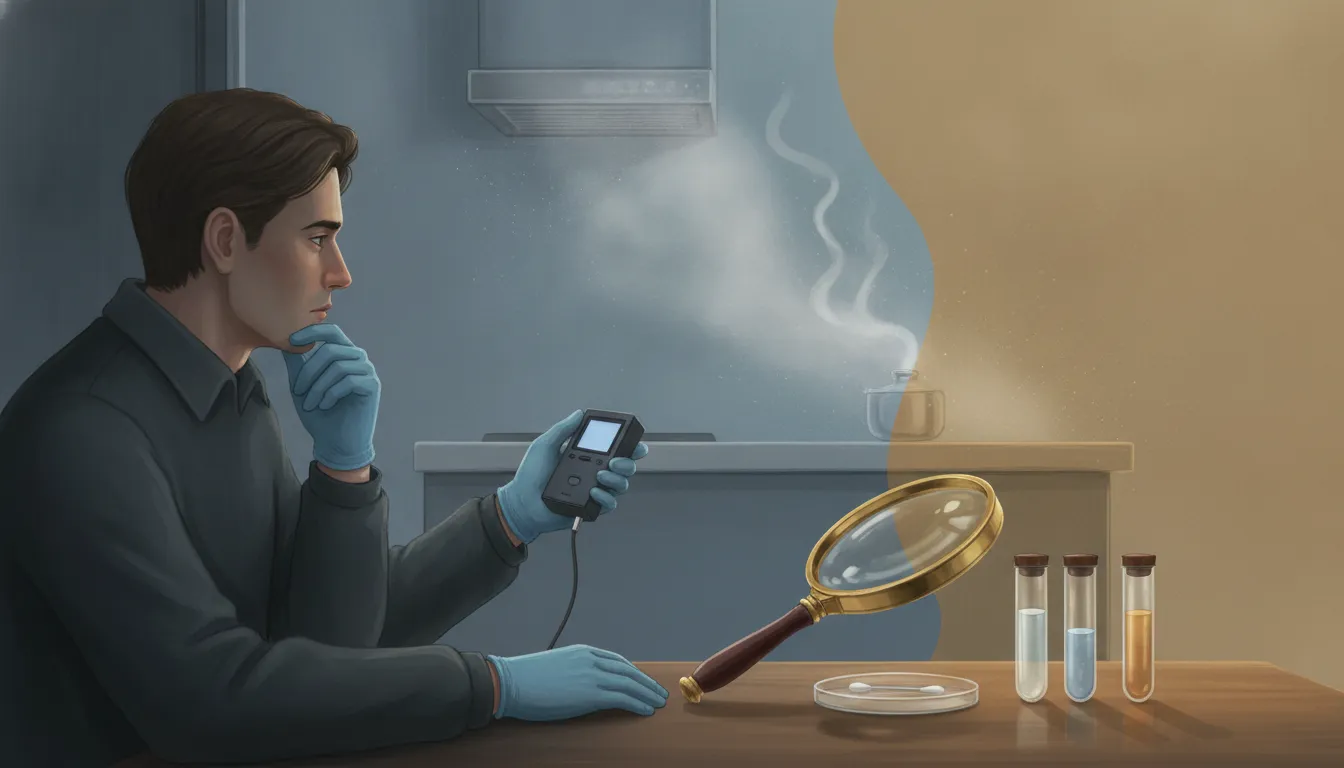
A burning-plastic smell in an apartment deserves attention. But the phrase “burned plastic as secret service weapon” makes a much larger allegation: it identifies a harmful substance, assigns intent, and names a perpetrator. An odor alone establishes none of those things.
Chemical-weapons history offers useful context, but not proof of a covert attack. The practical questions are more immediate: Is there an active hazard? Does anyone need medical attention? What evidence could establish the source?
This editorial interview-style Q&A draws on Chat History’s published discussion of chemical-weapons history. It is not a newly conducted interview, and the answers are explanatory synthesis rather than quotations or personal testimony.
Key Takeaways
- The historical material does not substantiate burned plastic being used as a secret-service weapon.
- A harmful substance, an actual exposure, and deliberate intent are separate questions.
- Odors and symptoms alone cannot identify a chemical agent or perpetrator.
- Immediate safety, medical assessment, and factual documentation take priority over speculation.
Table of Contents
- Separating a Chemical Hazard from a Weapon Claim
- What Chemical-Weapons History Actually Tells Us
- Responding to a Burning-Plastic Smell in an Apartment
- Documenting and Investigating Without Jumping to Conclusions
- Keeping the Investigation Proportionate
Separating a Chemical Hazard from a Weapon Claim
Does the available historical material support the “burned plastic as secret service weapon” claim?
No. The material describes recognized chemical agents, their effects, and historical uses. It does not document burned plastic being used by an intelligence service, nor does it establish a connection between an apartment odor and an assassination method.
That distinction is essential. Evidence that chemical weapons exist is not evidence that a particular smell comes from one. Likewise, documented poisonings do not identify the cause of an unrelated illness.
An unexplained exposure can deserve investigation without its most alarming explanation being established. Taking a possible environmental problem seriously means preserving that distinction, not dismissing symptoms and not prematurely assigning blame.
What makes something a chemical weapon rather than simply a dangerous chemical?
Toxicity and weaponization are related, but different. A substance can be hazardous in an industrial accident, a fire, or an improperly handled product without being a weapon. Deliberate use to cause harm introduces another question: purpose.
The Organisation for the Prohibition of Chemical Weapons explains that the definition includes toxic chemicals and their precursors, subject to permitted purposes and appropriate types and quantities. It is broader than a list of famous military agents.
Consequently, neither a familiar product name nor an unusual odor settles the issue. Investigators would need evidence about the substance, exposure circumstances, and intended use. The “burned plastic as secret service weapon” allegation cannot skip those steps.
Can plastic fumes be weaponized?
The general possibility of deliberately using a toxic substance to injure someone does not establish a specific method or incident. It would be misleading to turn that possibility into confirmation that ordinary burned-plastic fumes are a recognized secret-service weapon.
There are three separate questions:
- Hazard: Was something harmful present?
- Exposure: Did a person encounter it at a consequential level?
- Intent: Was it deliberately introduced to injure someone?
Each requires its own evidence. An odor may prompt a safety response. Symptoms may prompt medical assessment. Neither, by itself, identifies intentional poisoning.
What Chemical-Weapons History Actually Tells Us
Why is it misleading to treat all toxic fumes as the same thing?
Different agents injure the body through different mechanisms. Mustard agents damage tissue and can cause blistering. Phosgene primarily threatens the lungs. Nerve agents such as sarin and VX interfere with the signaling that controls muscles and other essential functions. Hydrogen cyanide disrupts the cells’ ability to use oxygen.
These are not interchangeable labels for “something poisonous in the air.” Their chemistry, exposure routes, persistence, and clinical effects differ.
Historical names can sound authoritative while explaining very little about a present-day incident. Calling an unidentified odor “nerve gas,” for example, adds a diagnosis that the available evidence has not earned. The same problem applies to describing unknown fumes as a covert weapon.
Does phosgene’s industrial connection to plastics prove a link to burning plastic?
No. Phosgene has industrial applications, including use in manufacturing processes associated with plastics. That fact does not mean every plastic product contains phosgene, or that every burning-plastic smell indicates its presence.
This is a common reasoning error: a chemical participates in making a material, so the finished material is assumed to release that chemical whenever damaged. The conclusion does not follow from the manufacturing connection alone.
Establishing what was released requires information about the actual material and incident. A “burned plastic as secret service weapon” claim cannot be supported simply by placing the words “phosgene” and “plastics” next to each other.
Can the smell distinguish mustard agents, nerve agents, or other poisons?
Not reliably. Historical descriptions associate mustard agents with characteristic odors, while sarin and VX are described as odorless. Even the familiar term “mustard gas” is misleading: the substance is a liquid at ordinary room temperature.
The useful lesson is not to build a household identification chart from these descriptions. It is that odor is an inadequate substitute for chemical identification.
A strong smell does not measure toxicity, and the absence of a smell does not establish safety. Moving closer to an unknown source to inspect it by smell is not a sound investigative method. A reported odor is an observation to document, not a laboratory result.
Do historical assassinations make a covert exposure explanation more likely?
The historical material includes deliberate poisonings involving recognized nerve agents. Those cases demonstrate that targeted chemical attacks have occurred. They do not establish that another person’s headache, apartment odor, or malfunctioning air conditioner has the same explanation.
Similarity at the level of fear is not similarity at the level of evidence. A documented case has specific findings, circumstances, and investigative conclusions. An unexplained building incident begins with unanswered questions.
The proportionate approach is to investigate the incident itself. Borrowing the conclusion from a famous poisoning may make the story feel complete, but it does not fill the evidentiary gaps.
Responding to a Burning-Plastic Smell in an Apartment
What should someone do first if an apartment smells like burning plastic?
Address immediate safety before debating the cause. If there is smoke, suspected fire, breathing difficulty, collapse, or another urgent danger, leave the affected area and contact local emergency services. Do not remain inside to collect evidence.
For suspected inhalation exposure, Poison Control’s inhaled-poison guidance provides practical first-response information. Contact the poison-information service appropriate to the country where the incident occurs.
A sensible sequence is:
- Get away from the suspected exposure.
- Obtain urgent assistance when symptoms or conditions warrant it.
- Report the odor or equipment problem to the responsible building contact.
- Document observations once doing so is safe.
A person does not need to prove the “burned plastic as secret service weapon” allegation before asking for help with a possible hazard.
What if the air conditioner blows hot air and someone feels sick?
Report both observations, but keep them separate. “The AC began blowing warm air at 8 p.m.” describes equipment behavior. “A headache started shortly afterward” describes a symptom. “Someone contaminated the HVAC system” is a proposed explanation.
Timing can be useful, but it does not establish the mechanism or intent. A qualified inspection can address equipment condition; a clinician can assess symptoms. Neither task should be replaced by speculation.
Useful details include whether the odor appeared only when the system operated, which rooms were affected, and whether others independently noticed it. Record what happened without repeatedly operating suspect equipment merely to recreate an exposure.
Do facial redness, headache, or nausea identify a particular poison?
No. Those symptoms alone do not establish a specific chemical, exposure dose, or perpetrator. A symptom deserves attention without being treated as proof of the explanation attached to it.
For medical assessment, describe the event plainly:
- When symptoms began and how they changed.
- Where the person was and how long they remained there.
- Whether smoke, an odor, or an equipment problem was noticed.
- Whether symptoms changed after leaving.
- Whether other people reported similar effects.
That account is more useful than presenting an unverified agent name as a diagnosis. Severe or worsening symptoms require prompt medical attention, not an extended search for a matching historical poison.
What about dioxin exposure symptoms and Agent Orange?
Agent Orange illustrates the importance of distinguishing immediate effects from longer-term consequences. Its history does not provide a symptom checklist for diagnosing an unknown apartment exposure.
The World Health Organization’s dioxin fact sheet offers supporting context on exposure and health effects. But a headache or skin change cannot, on its own, confirm dioxin exposure.
Nor should the name “Agent Orange” be applied to an unidentified household odor. Historical chemical mixtures, combustion emissions, and an individual’s symptoms are separate subjects. Connecting them requires evidence about the actual substance and exposure, not just overlapping descriptions of illness.
Documenting and Investigating Without Jumping to Conclusions
How should a tenant document a suspected chemical exposure?
Create a factual record. It should help another person understand what happened without requiring them to accept a theory first.
- Timeline: Dates, times, duration, location, and equipment activity.
- Observations: Odor descriptions, visible smoke, damage, or residue.
- Health information: Symptoms and any medical consultations.
- Communications: Messages to the host, landlord, building manager, or rental platform.
- Responses: Inspection findings, repair records, and incident reference numbers.
For example, “A sharp burning odor was noticeable near the vent at 9:10 p.m.” is a useful observation. “The vent delivered an intelligence-service poison” is an allegation requiring further support.
Keep original photographs and messages. Do not handle unknown residue or dismantle equipment to obtain a sample.
Would an apartment air-quality test settle the issue?
Not automatically. “Air-quality testing” is not one universal test for every substance. An investigation needs a question: What source is suspected? What should be measured? Where and when would sampling be informative?
The EPA’s indoor-air-quality resources provide general context for evaluating indoor environmental problems. A qualified environmental professional can explain the scope and limitations of a proposed assessment.
Ask what a test can establish before purchasing it. A result describing one measured substance does not necessarily characterize an earlier, intermittent event. Equally, detecting a chemical does not by itself prove deliberate introduction.
Testing should narrow uncertainty, not lend technical decoration to a predetermined conclusion.
Why does chain of custody matter for environmental evidence?
A sample is useful only if its origin and handling are adequately documented. Chain of custody records who collected it, where and when it was collected, and how it was transferred and stored.
This matters when results might support an insurance claim, rental dispute, or legal investigation. A photograph of an unidentified substance and a laboratory report are not automatically connected unless that connection is documented.
Ask a qualified professional about collection procedures before touching unknown material. Amateur sampling may introduce risk and uncertainty. For the “burned plastic as secret service weapon” claim, a credible investigation must establish both the evidence’s identity and its relationship to the alleged event.
How should someone report the incident to a rental platform, police, or lawyer?
Lead with verifiable facts and the assistance needed. A rental-platform complaint can describe an unsafe odor, equipment malfunction, symptoms, relocation, and the host’s response. A police report should distinguish observations from suspicions and include any specific evidence of threats or deliberate interference.
For legal advice, preserve the booking agreement, communications, expenses, medical records, and inspection findings. Reporting procedures and tenant rights vary by jurisdiction.
Nothing in the available historical material establishes tenant inspection rights in Georgia or a special chemical-reporting process in Batumi. Those details require local, authoritative guidance. Chemical-weapons history cannot substitute for the law governing a particular rental.
Keeping the Investigation Proportionate
What if fear of being targeted continues after the immediate incident?
Persistent fear deserves support, especially when it disrupts sleep, daily activities, or the ability to feel safe. Seeking help does not require dismissing an environmental concern.
Keep two tracks open: appropriate medical and building assessment, and support from a trusted person or qualified mental-health professional. Neither an online label nor a historical analogy can diagnose the situation.
The important boundary is between uncertainty and certainty. “The source remains unexplained” may be accurate. “A secret service is responsible” requires additional evidence. Repeated searches that return increasingly alarming stories do not necessarily move an investigation forward.
What is the most useful conclusion?
Respond to the hazard; investigate the explanation. Leave unsafe conditions, obtain appropriate medical help, document observations, and request competent assessment.
The “burned plastic as secret service weapon” claim is not substantiated by the available historical material. That does not make every reported smell harmless. It means the seriousness of a possible exposure and the truth of a covert-attack allegation must be assessed separately.
Chemical history is valuable when it clarifies distinctions. It becomes less useful when a frightening name is allowed to stand in for evidence.
|
Frequently Asked Questions
Is a burning-plastic smell proof of a chemical attack?
No. It is an observation that may warrant a safety response and inspection. It does not identify the substance or establish deliberate harm.
Does phosgene’s use in plastics manufacturing identify it in household fumes?
No. An industrial manufacturing connection does not establish what a particular product releases during an incident. Identification requires evidence about the actual material and exposure.
Can symptoms confirm the “burned plastic as secret service weapon” claim?
No. Symptoms can justify medical care, but they do not independently establish a chemical’s identity, deliberate introduction, or the involvement of an intelligence service.
Should evidence collection come before leaving an unsafe apartment?
No. Immediate safety and urgent medical needs come first. Document the incident only when it is safe, and leave unknown-substance sampling to qualified professionals.